
7:00 AM. Open asphalt. The calm of early dawn just breaking. Sun peeking over the ridges.
You’re on your way into the center and running a little late, but the tunes are on.
And then? Brake lights. All of them...
A digital sign on the shoulder: EXPECT HEAVY MACHINERY TRAFFIC AND DELAYS.
Traffic starts piling up all around you. The bumper-to-bumper crawl begins.
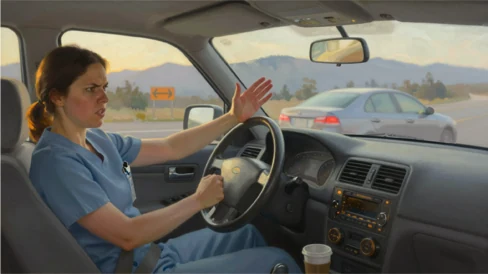
And then? A silver sedan cuts you off. No blinker. No warning. Misses your bumper by this || close.
Your grip tightens. White knuckling it. Heart rate spiking.
Initial thought? “What an absolute jerk! Is he trying to kill me?!”
Your hand goes to the horn.
Second thought: “...or he is rushing to the ER? Maybe he didn’t see me in his blind spot?...”
You move your hand away from the horn pad and give him space as your heart rate settles.
8:30 AM. You need to print an informed consent form during the patient’s consult.
Click. The machine groans. A red light flashes. Paper Jam.
The clock is ticking and the patient is waiting...
Initial thought? “This printer always breaks when I am in a hurry!”
Second thought: “This is just a hiccup and gives me an extra minute to review potential adverse reactions while I clear the jam.”
The machine whirs back to life.
12:15 PM. You are starving and have only one thing on your mind: nuggets.
A cafeteria worker is wiping the menu board clean.
Out of chicken nuggets today.
Initial thought? “This day is officially a disaster!”
Second thought: “...I’m just tired and four hours into a really hard shift and wanted just one thing to go my way today...”
Your tray slides forward. It was never about the nuggets.
3:00 PM. The afternoon patient is claustrophobic.
Inside the acrylic? They are coming apart.
Snapping at you through the intercom.
Short. Sharp. Angry.
Initial thought? “I’m doing everything I can for this patient and they are being so rude!”
Second thought: “They are not angry at me. They are terrified of being sealed inside a pressurized cylinder. Their anger is fear wearing a mask.”
Your voice stays low, slow, and steady. You talk them through the dive.
So, here is the thing about this one.
You didn’t learn it from a break room poster. You learned it on the job. Reading agitation as a symptom instead of an insult isn’t positive thinking. It’s clinical training.
In fact, you do it for patients every day. The only new part? Pointing it at your own workday.
5:00 PM. Same road. Same ridges.
Your workday is over and you’re already turning it into a story. The one you’ll tell at dinner and the one you’ll carry back into the center tomorrow morning.
Initial thought? “What an awful day.”
Second thought: “...was it, really?...”
So here is the truth: Some days the honest answer is yes. It was awful and reframing it does not make it better, and pretending it does helps nobody.
But most days the answer is: very little of it. And yet those parts get to stand in for the whole, because nobody stopped to check.
So here is the thing. You will not get to choose most of what lands on your desk today, this week, this month, or in what’s left of 2026. Personal problems. Traffic. Road rage. Spilt milk. Incomplete referrals and patient records. Annoying neighbors. Systems going down. Rainy days. Being short-staffed on the day you need help the most.
What you do get to choose though, is how you react to it, what you say about it to yourself and those around you, and how you carry it the rest of the day.
So, forgive yourself for that first thought. The white knuckles. ‘Absolute jerk!’ ‘This day is a disaster...’ None of that? Is a character flaw. It’s just a nervous system doing its job.
The first thought is just weather. The second one? Is you.